
Introduction
The enactment of the Variable Capital Company regime in the Dubai International Financial Centre marks a significant structural development in regional and international wealth planning. This DIFC Variable Capital Company (VCC) Structures Overview provides a detailed legal and practical analysis of how the DIFC VCC operates, why it matters for sophisticated investors, and how it compares with traditional holding and SPV frameworks.
For international family offices, ultra high net worth individuals, private equity sponsors, and cross-border entrepreneurs, the DIFC VCC offers a consolidated and flexible structuring platform within a respected common law jurisdiction. It combines institutional governance standards with the adaptability required for modern private capital deployment.
The DIFC has long positioned itself as a leading financial centre bridging Europe, Asia, and Africa. The introduction of the DIFC VCC strengthens that position by providing a vehicle capable of housing multiple strategies, segregating risk, and facilitating capital management within a single corporate structure.
Legal Foundation of the DIFC Variable Capital Company
The DIFC Variable Capital Company is established under dedicated DIFC legislation and regulated within the broader DIFC framework. Unlike a traditional company limited by shares, the DIFC VCC benefits from variable share capital and the ability to create segregated cells within a single legal entity.
The legal architecture draws from international best practice. It reflects elements found in jurisdictions such as Singapore and Luxembourg while being tailored to the DIFC’s independent common law courts and regulatory ecosystem.
A DIFC VCC may be structured as a standalone entity or as an umbrella vehicle with segregated cells. Each cell can pursue a distinct investment strategy while remaining part of the same overarching company. This design allows flexibility without sacrificing governance integrity.
The regulatory treatment will depend on the intended activity. Certain structures may require authorisation by the Dubai Financial Services Authority, while others may operate in a more private unregulated capacity. Careful legal analysis is essential at the structuring stage to determine the appropriate classification.
Core Structural Features of the DIFC VCC
Variable Share Capital
The defining feature of the DIFC VCC is its variable capital framework. Shares may be issued and redeemed at net asset value, subject to compliance with the applicable regulations and constitutional documents.
This allows capital to move efficiently in and out of the structure. Investors can subscribe or redeem without triggering the rigid capital maintenance procedures associated with conventional companies. For private capital strategies, this flexibility is highly valuable.
The ability to distribute capital rather than only accounting profits further enhances liquidity management. This feature is particularly relevant for closed-ended strategies, real estate holdings, and private credit allocations.
Segregated Cells and Ring Fencing
A DIFC VCC may establish segregated cells. Each cell maintains its own assets and liabilities, legally ring fenced from the others. Creditors of one cell generally have recourse only to that cell’s assets.
This structure allows multiple strategies to coexist within one corporate entity while maintaining liability separation. In practice, this reduces the need for multiple standalone SPVs across jurisdictions.
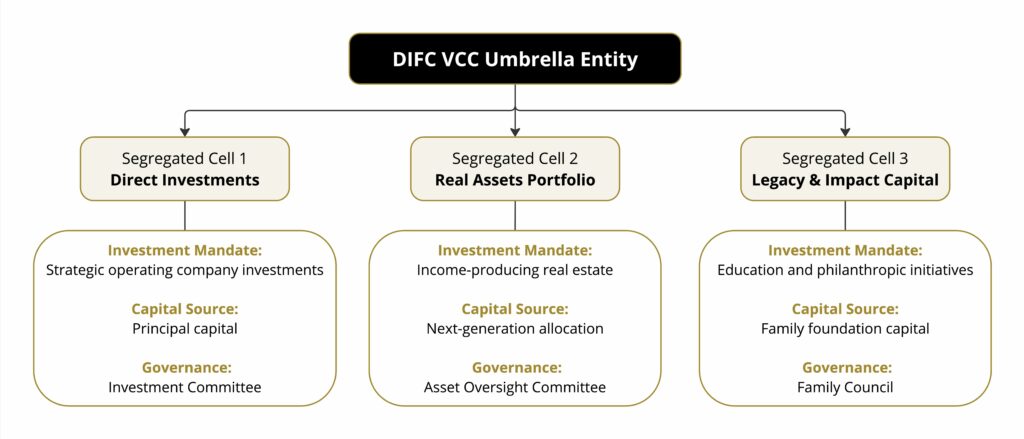
Consider a family office managing private equity, real estate, and venture capital. Instead of forming separate offshore companies for each strategy, the family may allocate each asset class to a separate cell within the DIFC VCC. Governance oversight remains centralised, yet risk is compartmentalised.
The structure becomes clearer when viewed visually. The diagram below illustrates how a DIFC Variable Capital Company operates as an umbrella entity with multiple segregated cells, each pursuing distinct strategies while remaining legally ring fenced.
Strategic Applications for Family Offices and Private Investors
The DIFC Variable Capital Company is particularly well suited to complex private wealth arrangements.
For family offices, the structure enables consolidation of fragmented holdings. Many families historically operate through numerous entities in the Cayman Islands, BVI, or other offshore centres. Over time, this creates duplication of administration, inconsistent governance, and rising compliance costs.
By contrast, a DIFC VCC can serve as a central holding and investment platform. Separate cells can be created for:
- Direct operating company investments
- Regional and international real estate
- Liquid portfolio allocations
- Philanthropic or impact initiatives
Although the use of cells provides separation, the family benefits from unified oversight, consistent reporting standards, and simplified succession planning.
Entrepreneurs following a liquidity event may also find the DIFC VCC attractive. Sale proceeds can be rolled into the structure and deployed across multiple strategies. Co investors can be admitted at the cell level, allowing transaction specific participation without disturbing other allocations.
Institutional co investors often prioritise governance clarity. The DIFC’s independent courts and regulatory framework provide comfort in cross-border arrangements. Independent directors, advisory committees, and structured reporting can be embedded within the VCC’s constitutional documents.
Comparison with Traditional SPV and Holding Structures
Historically, sophisticated investors in the region relied heavily on layered SPV chains. A typical structure might include a holding company in one jurisdiction, property SPVs in another, and investment vehicles elsewhere.
While this model remains functional, it can create complexity. Each entity requires maintenance, accounting, and regulatory compliance. Cross-border coordination becomes burdensome, particularly as portfolios grow.
The DIFC Variable Capital Company offers an alternative approach. Instead of multiplying entities, the investor can consolidate strategies within one umbrella company using segregated cells.
The practical advantages include reduced administrative duplication, clearer governance architecture, and potential long term cost efficiencies. Importantly, ring fencing is preserved without the need to establish entirely separate legal entities for each asset.
This consolidation does not eliminate the need for careful tax and regulatory analysis. Cross-border investments must still be assessed in light of local laws and double tax treaties. However, the structural simplicity of the DIFC VCC often enhances transparency and control.
Governance, Substance, and Regulatory Positioning
One of the most compelling features of the DIFC VCC is its governance profile. The DIFC operates under a common law framework with its own courts and internationally recognised regulatory standards.
For family offices with global assets, enforceability and legal certainty are critical. The DIFC’s judicial system enhances predictability in shareholder disputes, director duties, and contractual enforcement.
Governance can be tailored to the needs of the investor. Structures may incorporate independent directors, investment committees, and reserved matter provisions. This allows a family office to institutionalise decision making without relinquishing ultimate control.
Substance considerations are equally important. The UAE has developed a competitive corporate tax framework and maintains an extensive network of double tax treaties. A DIFC VCC can be structured with appropriate substance in line with regulatory expectations. Professional advice is essential to ensure compliance with economic substance and reporting requirements.
Practical Structuring Illustration
Consider a multi generational family office with USD 750 million in assets under management. The portfolio includes private equity, international real estate, regional operating businesses, and a philanthropic education initiative.
Under a traditional model, each asset class might sit within separate offshore holding companies, resulting in a web of entities across jurisdictions.
Using a DIFC Variable Capital Company, the family could establish an umbrella VCC with multiple segregated cells. One cell holds private equity interests, another holds real estate assets, a third manages operating company stakes, and a fourth supports philanthropic initiatives.
Each cell’s liabilities remain confined to its own assets. Governance remains centralised at the VCC board level. Reporting is consolidated. Succession planning is simplified because share classes and cell participation can be tailored to different branches of the family.
International Competitiveness of the DIFC VCC
Globally, variable capital vehicles have gained traction. Singapore’s VCC and Luxembourg’s fund structures are widely used. The DIFC Variable Capital Company positions Dubai within this competitive landscape.
What distinguishes the DIFC VCC is its regional proximity, its role as a gateway between continents, and its alignment with international governance standards. For investors focused on the Middle East, Africa, and South Asia, the DIFC provides geographic and commercial relevance.
The official DIFC announcement emphasised the objective of enhancing Dubai’s status as a global capital hub. Early adopters of the DIFC VCC framework may benefit from structural clarity and regulatory alignment at a formative stage of market development.
Risks and Considerations
While the DIFC Variable Capital Company offers significant advantages, it is not a universal solution. Structuring decisions must account for tax exposure in underlying jurisdictions, regulatory licensing requirements, and investor profile.
Not every strategy will be suitable for placement within a VCC. Careful drafting of constitutional documents is critical to preserve ring fencing and governance clarity.
Professional legal, tax, and regulatory advice should be obtained before implementation.
Conclusion
This DIFC Variable Capital Company (VCC) Structures Overview demonstrates that the DIFC VCC is more than a technical innovation. It represents a structural evolution in how sophisticated capital is organised within the region.
By combining variable share capital, segregated cells, and institutional governance standards within a respected common law jurisdiction, the DIFC VCC offers a consolidated platform for multi strategy investing.
For family offices, entrepreneurs, and institutional partners seeking flexibility without sacrificing legal certainty, the DIFC Variable Capital Company provides a compelling and internationally competitive solution. Careful structuring and professional advice remain essential, but the opportunity is clear.
The content of this article is intended to provide a general guide to the subject matter. Specialist advice should be sought about your specific circumstances.
While these documents are accurate as of the date of issue, they may be subject to change in the future.
FAQs
What is a DIFC Variable Capital Company?
A DIFC Variable Capital Company is a corporate vehicle established in the DIFC that allows variable share capital and the creation of segregated cells within one legal entity.
Who typically uses a DIFC VCC?
Family offices, ultra high net worth individuals, private equity sponsors, and institutional investors commonly consider the DIFC VCC for multi strategy structuring.
Can assets be segregated within a DIFC VCC?
Yes. Segregated cells allow assets and liabilities to be ring fenced within the same umbrella company.
Is the DIFC VCC regulated?
Depending on the structure and activities, regulatory authorisation from the Dubai Financial Services Authority may be required.
How does the DIFC VCC differ from a traditional company?
The DIFC VCC has variable capital and may redeem shares at net asset value, unlike a standard company subject to strict capital maintenance rules.
Can a DIFC VCC distribute capital?
Yes, subject to regulatory and solvency requirements, capital distributions are permitted.
Is the DIFC VCC suitable for cross border investments?
It can be used for cross border structuring, but tax and local law analysis must be conducted in each relevant jurisdiction.
Does each segregated cell require a separate legal entity?
No. Cells exist within the same umbrella company but are legally ring fenced from one another.
How does the DIFC VCC support succession planning?
Different share classes and cell participations can be allocated to various family branches, facilitating generational transition.